BLOOMINGTON, Ill. – This summer, six physics students participated in paid, on-campus summer research internships supported through Illinois Wesleyan alumni donations and university funding. Their projects spanned a broad range of physics, from semiconductor research to the development of curriculum for IWU’s emerging focus on quantum science.
Expanding these opportunities has been a priority for Professor and Chair of Physics Narendra Jaggi.
“Students should not have to choose between financial necessity and meaningful technical experience,” Jaggi said.
Until three years ago, the physics department was generally able to support one paid summer research student through the generosity of Bill Murphy ‘98. Since then, additional alumni have contributed to the program, allowing the department to support six paid summer research students each year.
Three of those positions are supported directly through alumni donations, while the remaining positions are funded through startup funds provided by the Provost to new tenure-track faculty as they establish their research programs. The Physics Alumni Summer Research Scholarships provide a $5,000 stipend, with campus housing also covered for students who are not from McLean County.
“Our goal has been to ensure that students can remain on campus during the summer, work closely with faculty and be paid for that work,” Jaggi said.
Physics and music double major Ben Heinz ‘27 spent much of the summer working with Jaggi on the development of computational laboratory materials for QST 151, an introductory quantum science and technology course that is planned for the spring semester.
The course will build on several experimental versions that IWU has offered in recent years as faculty have explored how best to prepare students for the rapidly developing field of quantum science and technology. Offering a pathway to quantum studies that is accessible to students from a variety of interests is a pillar of the university’s new Fisher Center for Interdisciplinary Quantum Science & Engineering.
Heinz is helping develop a new hands-on component of the course: computational labs that will introduce students to quantum computing through software.
Much of Heinz’s summer involved writing the labs, discussing them with Jaggi and then testing them with other physics students. Their feedback helped him revise the exercises and identify places where instructions or concepts could be clearer.
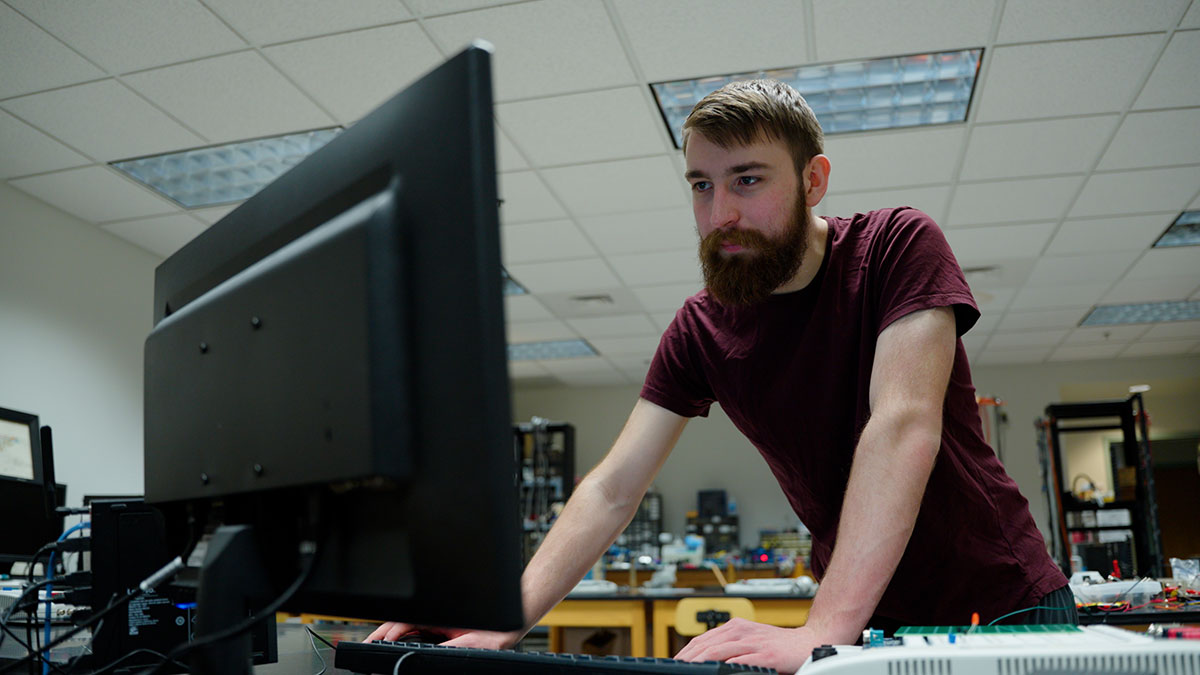
“This is something that I am really proud of,” Heinz said. “And this is one of the highest quality opportunities that I’ve been involved in while at Illinois Wesleyan.”
While Heinz’s project focused on preparing future students to enter quantum science, Courtney Maslana ‘28 spent her summer investigating a more fundamental question involving semiconductors, water and electrical signals.
Maslana is a double major in music and biochemistry, is pursuing an engineering path and is adding a physics minor. She worked with Assistant Professor of Physics Abdel Isakovic on research involving the interface between a semiconductor and an electrolyte.
The summer project used a small device made from a semiconductor material. Maslana added water or deuterated water to the device and observed changes in its transport properties.
The work builds on earlier research by Isakovic and collaborators examining how the device responds to different materials. Maslana conducted research in the spring on amino acids and the device’s potential for chemical sensing, including the detection of amino acids.
Maslana’s summer research connects directly to her biochemistry studies while also giving her experience with experimental physics. As the project moves forward, she hopes to continue investigating amino acids and chemical sensing.
“This summer experience solidified the fact that I want to do research as my job,” Maslana said.
Both students’ experiences reflect the broader educational value Jaggi sees in summer research.
“A meaningful summer research experience can have a lasting impact on a student's development, whether it takes place on campus, at a national laboratory or in industry,” he said.
Jaggi also sees the growth of summer research as part of a larger effort to build a culture of undergraduate research in physics at IWU. The department is a small program at a small liberal arts university, making the number of students receiving summer research support notable.
“Thanks to the generosity of our alumni, the commitment of our faculty and the Provost’s investment in new faculty research programs, we’re beginning to see that culture emerge,” Jaggi said.
As IWU develops its new quantum science initiatives, those opportunities may continue to expand. For students like Heinz and Maslana, the value of the experience is already evident as they go into the new school year with deeper technical knowledge, greater confidence as researchers and a clearer sense of where their interests can lead.