Wanda Lindquist ‘26 has always had a mind for physics.
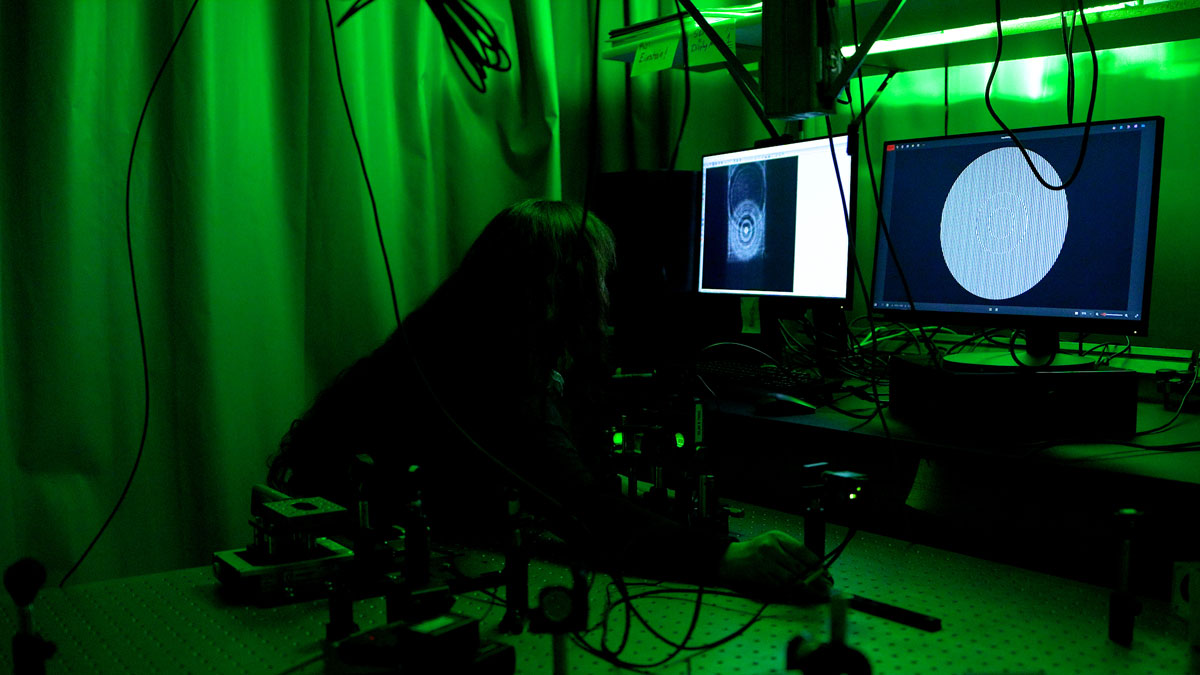
“I remember, as a kid lying in my room at night, I would imagine balls bouncing around the room, thinking about what angles they would bounce at off the walls,” Wanda said.
She always felt confident in her intuitions about the physical world that we can see and imagine, until she qualified that confidence with a caveat.
“I had no idea we were going to have this whole ‘Quantumania’ thing,” she said, referencing the 2023 Ant Man sequel.
Wanda’s experience is shared by an entire field of study – for over a century, physicists
have peeled back layers of mind-bending mysteries as they dive deeper into the fundamental
building blocks of the universe. For the last decade or so, the possible practical
applications of those mysteries have exploded in the popular imagination as dozens
of exciting buzzwords that mask the fiendishly complex challenges of quantum physics.
That monumental challenge is why, as an IWU physics major, Wanda became among the
first undergraduate students in the country to pursue quantum optics and computing
at a liberal arts college, joining her classmates in earning multiple internships
at nationally renowned programs and laboratories.
Come next school year, she will be followed by the first students to perform coursework and research with the Center for Natural Sciences’ new Fisher Center for Interdisciplinary Quantum Science & Engineering, thanks to a $3.5 million gift from IWU trustee Ann Marquis Fisher '82 and her husband Alan. With a suite of cutting-edge technology enabling unique curricula and research opportunities within a liberal arts tradition, IWU aims to become a hub of quantum science and engineering in the Midwest and beyond.
* * *
Quantum physics, synonymous in popular culture with “mind-boggling science,” is more approachably described by Ames Professor of Physics Gabriel Spalding as “recognizing that the things you learned about in your pre-college education, like an electron or photon, were taught in a way that made sense because it was a simple model, but it wasn't the whole story.”
The “whole story” of quantum physics has been most recently, and famously, hinted
at in the Christopher Nolan film Oppenheimer. The titular director of the Manhattan
project and early quantum physicist finds himself in tense conversations with Albert
Einstein, who is discomfited by Robert Oppenheimer’s field.
“Here we are, lost in your quantum world of probabilities,” film Einstein says.
He refers to the unintuitive strangeness of the universe at the very smallest scales. The particles that make up atoms and that carry forces across space and time appear to follow a different set of rules from the world as we experience it. Yet somehow, due to mysteries we have yet to solve, the rules of Einstein’s world of planets and stars emerge from the probabilistic quantum world.
Despite the many remaining mysteries, physicists and engineers have used the known principles of quantum physics to create far more technologies than one may realize. From atomic bombs to MRIs to GPS navigation, a technological revolution has been steadily making its way through the last century of progress in a world of science we can scarcely imagine.
Take, for example, the computer on your desk or phone in your hand.
The scales of quantum science and engineering are beyond human intuition, but the field of quantum computing might be best at showcasing what IWU students will pursue within the Fisher Center, especially since several IWU physics students have already contributed to research in the field.
But it is especially useful for the rest of us because of the relatable problem that all computer engineers face: They are running out of space. Not space in the body of the device on your desk but in the gaps in the microchip transistors that enable a computer to store and process data.
Each transistor is basically a gate that can open or close to control the flow of electricity through a microchip. Transistors being open or closed, “one” or “zero,” make up the bits of binary code, and the smaller those transistors get, the more bits can fit into something like a laptop or cell phone.
But how small can transistors get?
Today, transistors in consumer electronics are measured in nanometers, or billionths of a meter. A human hair is about 100,000 nanometers wide. The smallest transistors in production today are about three nanometers wide, or the width of about thirty hydrogen atoms lined up side-by-side.
When you start measuring distances in terms of a few atoms, the rules start to change. The electrons that orbit those atoms begin to look less like a flowing current of electricity and more like clouds of probability that might randomly appear in places you can’t predict, like the other side of a closed transistor. Suddenly, what was once a perfectly controlled system of encoded information becomes a corrupted mess.
If you can wrap your mind around that, you have begun to understand just one of the problems quantum scientists and engineers like Wanda are solving.
* * *
“The quantum revolution,” according to Professor and Chair of the Physics Department Narendra Jaggi, “has acquired new significance in the last quarter century because of the extraordinary potential to solve problems that mankind thought were impossible to solve.”
In that time, the state of Illinois has become a global hub of quantum science and engineering, not least Central Illinois, where the University of Illinois Urbana Champaign hosts faculty and graduate students working at the forefront of quantum engineering’s most exciting solutions.
Jaggi himself had the opportunity to work with the U of I’s Nadya Mason – one of the most prominent researchers grappling with the mind-bending physics of quantum computers, delving into topics as sci-fi-sounding as "two-dimensional superconductors” – and he brought back to IWU a singular ambition.
“Four years ago, I decided we were going to be a part of this,” he said. Illinois Wesleyan was going to become the one institution that students from the Midwest and beyond would attend to study quantum science and engineering as an undergraduate.
That ambition began with Jaggi’s “intro to quantum physics” course for juniors and seniors, which Wanda found herself accidentally enrolled in as her very first class session as a freshman at IWU.
“I met a lot of upperclassmen in the physics department in that class,” Wanda said, “and they would help me, because I needed some help in the beginning, but I had fun the whole time.”
The class introduced Wanda to quantum physics in intensely mathematical terms, accidentally throwing Wanda into her first day at IWU as a student with concepts far beyond what she had encountered before, but she had a leg up in feeling comfortable and confident on campus.
Wanda graduated from IWU this past spring, but she has been on the Illinois Wesleyan grounds ever since she was a child imagining the trajectories of bouncing balls. Being the daughter of IWU physics alum and chief information officer Rick Lindquist ‘99, she is also one of Professor Narendra Jaggi’s “grandstudents,” as he calls them.
“When I first talked to Professor Spalding on campus as a student, he told me, ‘I remember when you were this tall,’” Wanda said, holding out her hand a few feet from the ground.
About a decade after Spalding’s recollection, Wanda emerged from her first-year encounter with an upper level quantum physics class as a poster child for the future of quantum physics at IWU, and as a bright young scientist interested in the solutions that may make quantum computers a reality.
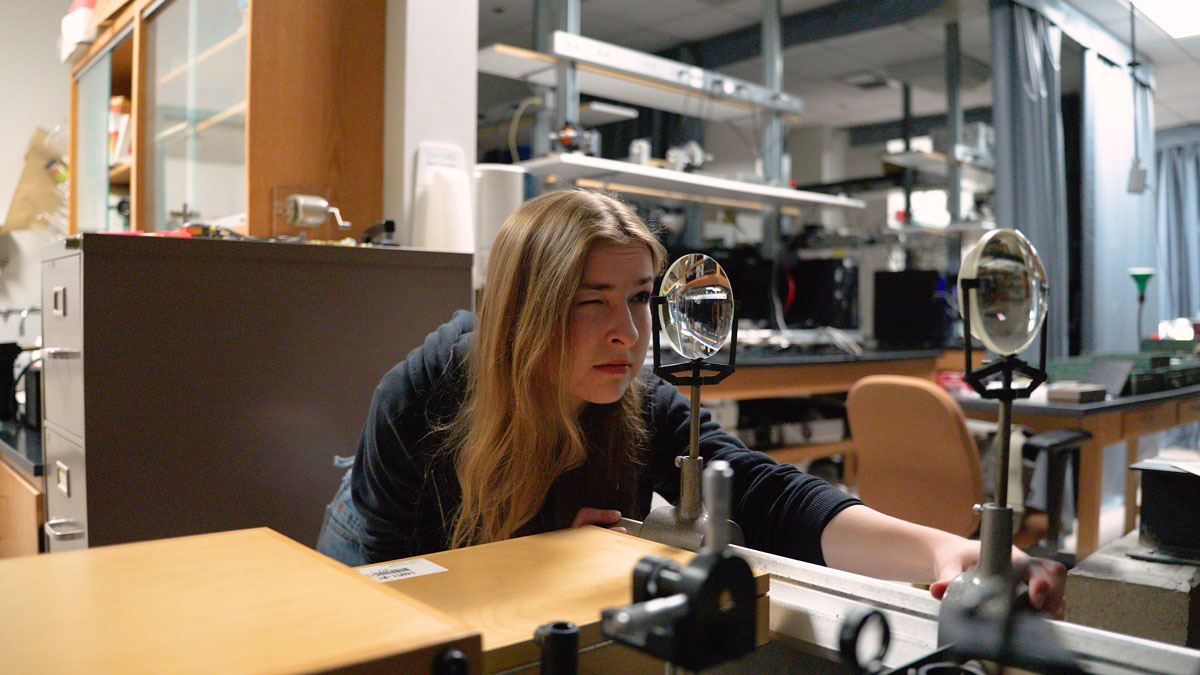
“I like playing with lasers,” Wanda said, “and doing things with lasers happens to help people do quantum computing.” Specifically by “using lasers to trap atoms.”
Thanks to Wanda’s work in quantum optics – the physics of light at quantum scales – she has been able to complete two internships “playing with lasers” at Argonne National Laboratory, one of the most prestigious and advanced physics labs in the world located in the Chicago suburbs. She plans to continue her research this fall as a grad student at the University of Arizona.
If the kind of work that Wanda is doing bears fruit, the applications of quantum computing include “everything from chemistry, physics, materials, finance, climate science, drug design, you name it,” Jaggi said.
Any kind of problem that involves astronomical numbers of unpredictable parameters interacting with each other, whether it's modeling combinations of molecules, atmospheric dynamics or financial transactions, quantum computers will be able to trivialize the process of studying these phenomena.
That is the revolution that Jaggi, the Fishers and the IWU physics department want the University to be a part of.
* * *
Today’s first-year IWU students, rather than repeating Wanda’s fortunate mistake, can take a new “quantum physics for all” course designed to be a gateway into the depth and breadth of quantum science and engineering at IWU, facilitated by the Fisher Quantum Center.
“We at Illinois Wesleyan have the first undergraduate level concentration in quantum science and technology in the Midwest,” Jaggi said, accounting for the depth of study our students have and will achieve.
As for breadth, “because we are at a liberal arts institution, this is our philosophy, that we don’t teach anything as a pure skill in a narrow field,” Jaggi said. “The arc of the program includes quantum physics, quantum chemistry, quantum mathematics, ecological implications of quantum technology and professions in quantum science and technology.”
The unique character of IWU’s education has already drawn a vast range of interdisciplinary interest to the field. Ben Heinz ‘27, a double major in physics and music performance, conducted research on the environmental and ethical implications of quantum computing while also completing an internship at Fermilab, the other internationally prestigious physics lab in the suburbs of Chicago. And Ahnnika Hess ‘27, a physics and art double major, performed research at Northwestern University’s Center for Photonic Communication and Computing while being inspired by her study of quantum physics to create stunning glasswork art depicting a space-time singularity.
“It's one of my favorite pieces, and I've gotten three commissions from it,” Ahnnika said.
These are some of the students who have been able to make incredible achievements as physics undergrads even before the creation of the Fisher Quantum Center. With millions of dollars in investment, future students will have access to the same kinds of lab equipment, visiting faculty, concentrations and research opportunities that are boasted by the R1 institutions of one of the most research-heavy states in the country. And they will do so while also becoming the thoughtful, persuasive and inspiring leaders that an IWU education creates.
“I'm extremely grateful to the alumni who have supported us in building this program the last four or five years, and some of them have been extraordinarily generous,” Jaggi said. “We are looking forward to creating a program that will be distinctive at the national level, a program that will be recognized for the first of its kind in providing undergraduate education, instruction and research in quantum science that has both breadth as well as depth.”